Community Development is Workforce Development

I recently had the need to reread an assessment of Maine’s forest industry workforce needs, Transforming Maine’s Future Forest Workforce, developed to support the FOR/Maine effort and released in 2024. This effort was thorough and included an exploration of specific forest industry career paths (e.g., loggers and millwrights) and the training needed to begin and then build a career in these fields.
In addition to this type of information, the report contained a summary of stakeholder engagement the authors had undertaken – basically meeting with forest industry workers, employers, and students. The section below is a direct quote from the summary of discussions with employers.
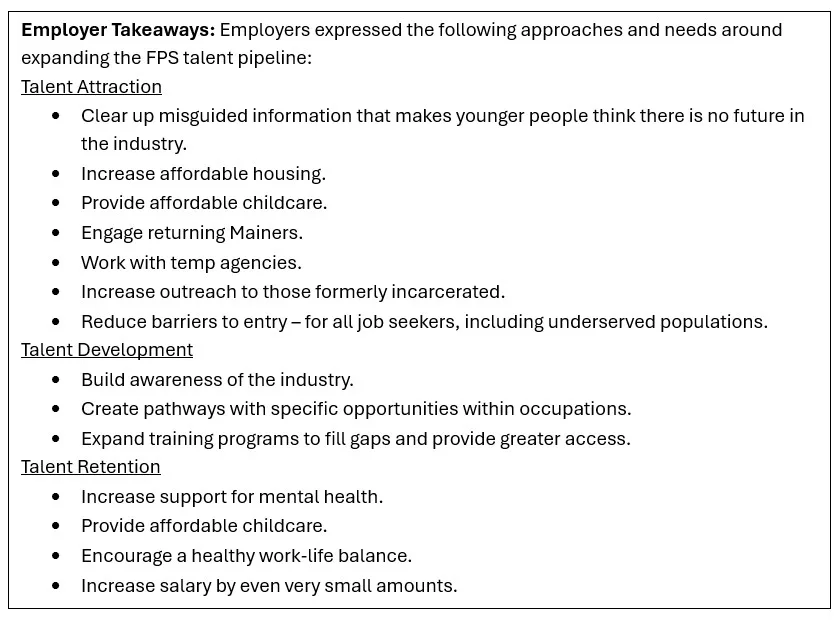
Divided into “Talent Attraction” (getting people into the industry), “Talent Development” (growing skills for existing industry workforce), and “Talent Retention” (keeping people working in the industry), something caught my attention: employers weren’t focused on particular skill sets or training programs (as important as those are). Instead, much of their focus and ideas centered on the host community and on how it needs to be a place where employees can and want to live.
People working in our industry need homes they can afford to buy, daycare centers that can watch their children, and mental health resources. I recently met with a sawmill in the Northeast that told me they are having trouble attracting new workers to the area – and one of the key reasons is that the local hospital just closed.
The fact that a mill or logging firm is part of a community isn’t a surprise, but it’s easy to overlook. Yes, we need students to learn about careers in the forest industry, and we need training programs that teach people how to operate equipment, weld, and run a paper machine. As an industry, we need to maintain our focus on building training programs that deliver ready-to-work talent. FRA has been working to strengthen this workforce pipeline through support of the Jobs in the Woods Act, which would provide communities with resources to develop career pathway programs that connect students and job seekers with opportunities in forestry, whether in the woods or at the mill.
Our industry needs to be engaged members of the community, and support vibrant towns that employees want to live in. We need to support housing developments, so that people have an affordable place to call home. We need to support safe, reliable childcare so that more people can enter the workforce. And of course, we need restaurants, shops, little league teams and scout troops – these and so many other things turn a dot on the map into a community where people want to stay and put down roots.
Additional Reading
You may also like
From Forest to Mill: Sharing Knowledge Across the Wood Supply Chain
National Forest Products Week | October 18–24, 2026 The forest products…
The Future of the Forest Product Industry Depends on the Next Generation
A few weeks ago, I had the opportunity to attend the…
Summary of Business: FRA 2026 Joint National and Lake States Region Fall Meeting
FRA’s Joint National and Lake States Region Fall Meeting brought members…