America’s Retirement Wave Is Reshaping the Wood Supply Chain
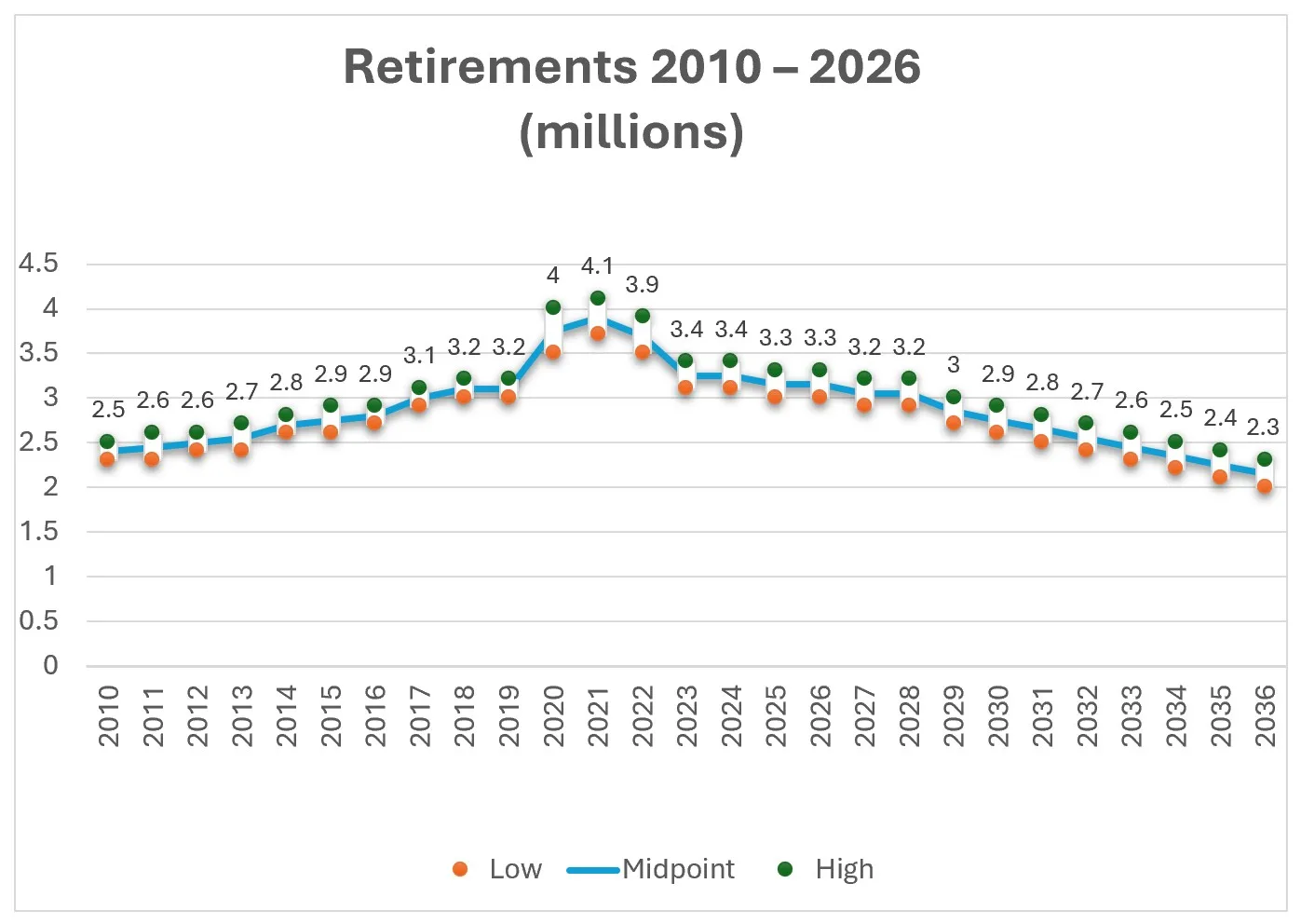
The United States is in the middle of the largest retirement wave in modern history — and it is transforming the workforce realities facing logging contractors, mills, truckers, and every link in the wood supply chain. Between 2010 and 2026, 48–55 million Americans retired, a demographic shift driven almost entirely by the aging of the Baby Boom generation. And this transition isn’t over: elevated retirements will continue through at least 2028 before stabilizing at historically high levels.
For the forest sector, the impact is direct and unavoidable.
Boomer‑Heavy Occupations Are Being Hit First
Forest industry‑critical occupations — logging, trucking, and mill operations — are among the most Boomer‑dependent in the entire U.S. economy. In many of these roles, 30–45% of workers are already over age 55, meaning retirements are not a future concern; they are a daily operational reality.
Annual retirements in these jobs run 4–6% of the workforce, far outpacing the number of new workers entering through training programs, apprenticeships, or local labor pools. Even if every forestry, CDL, and millwright program doubled enrollment, the math still wouldn’t balance.
Rural Labor Markets Are Aging Faster
The challenge is even more acute in rural America — where FRA members operate. Rural counties are older, smaller, and aging faster than the nation as a whole. That means fewer available CDL drivers, equipment operators, millwrights, and mechanics at the exact moment retirements are accelerating.
Members across the country report the same pattern: job postings stay open longer, competition for skilled workers is rising, and the pipeline of young workers is too thin to replace those leaving.
This Is Structural — Not Cyclical
It’s important to understand what this workforce shift is not. It is not a temporary labor‑market fluctuation. It is not a pandemic‑driven anomaly. It is not something that will “correct itself” when the economy cools.
This is a structural demographic shortage. Even after the last Boomers retire, annual retirements will remain elevated — 2.2–2.6 million per year through the mid‑2030s. The workforce will not return to pre‑2010 conditions.
Building Long‑Term Workforce Capacity: The Role of the Jobs in the Woods Act
Addressing the forest sector’s workforce shortage requires long‑term, durable solutions — and the Jobs in the Woods Act is a cornerstone of that strategy. The bill invests directly in forestry workforce training, creating hands‑on programs that prepare young adults and career‑switchers for high‑demand roles such as equipment operators, log truck drivers, and mill technicians.
Crucially, the Act strengthens local training pipelines that keep workers in the rural communities where they are most needed. It supports regional training hubs, lowers training costs, and tailors curricula to employer needs — all essential in a sector where 30% of logging business owners plan to exit within five years and retirements are outpacing new entrants.
When paired with broader long‑term solutions — expanded training capacity, targeted immigration pathways for essential roles, and rural workforce investments — the Jobs in the Woods Act provides a practical, scalable framework for stabilizing the wood supply chain for the next decade and beyond.
The Path Forward
The retirement wave is here. It is measurable. It is structural. And it will define the next decade of workforce policy. For FRA members, acknowledging this reality — and advocating for durable solutions like the Jobs in the Woods Act — is essential to keeping America’s forests healthy, its mills running, and its rural economies strong.
Additional Resources
The Senate Committee on Agriculture, Nutrition, and Forestry
Farm Bill 2.0