From Forest to Mill: Sharing Knowledge Across the Wood Supply Chain

National Forest Products Week | October 18–24, 2026
The forest products industry is built on connections. From the forests where timber is grown and harvested to the trucks transporting raw materials and the mills manufacturing everyday products, each part of the wood supply chain plays an essential role. Connecting the people, businesses, and expertise across this supply chain is central to FRA’s mission.
During National Forest Products Week, FRA celebrates everyone who makes this industry possible. It is also an opportunity to recognize something equally important: the knowledge and experience that help the industry navigate challenges, improve operations, and prepare for the future.
Insight is another pillar of FRA’s work, reflected in its quarterly Technical Releases (TRs), which bring together research, industry experiences, practical guidance, and emerging technologies to inform and support professionals throughout the wood supply chain.
Technical Releases are an FRA member benefit, and members must log in to the FRA website to access them. FRA also occasionally makes select releases publicly available when the information has broader value to the industry. One recent example is 26-TR-24: Update on Impact of Skyrocketing Fuel Prices on Forest Products Transportation, which FRA made available to the public because of the widespread impact of rising diesel costs on the wood supply chain.
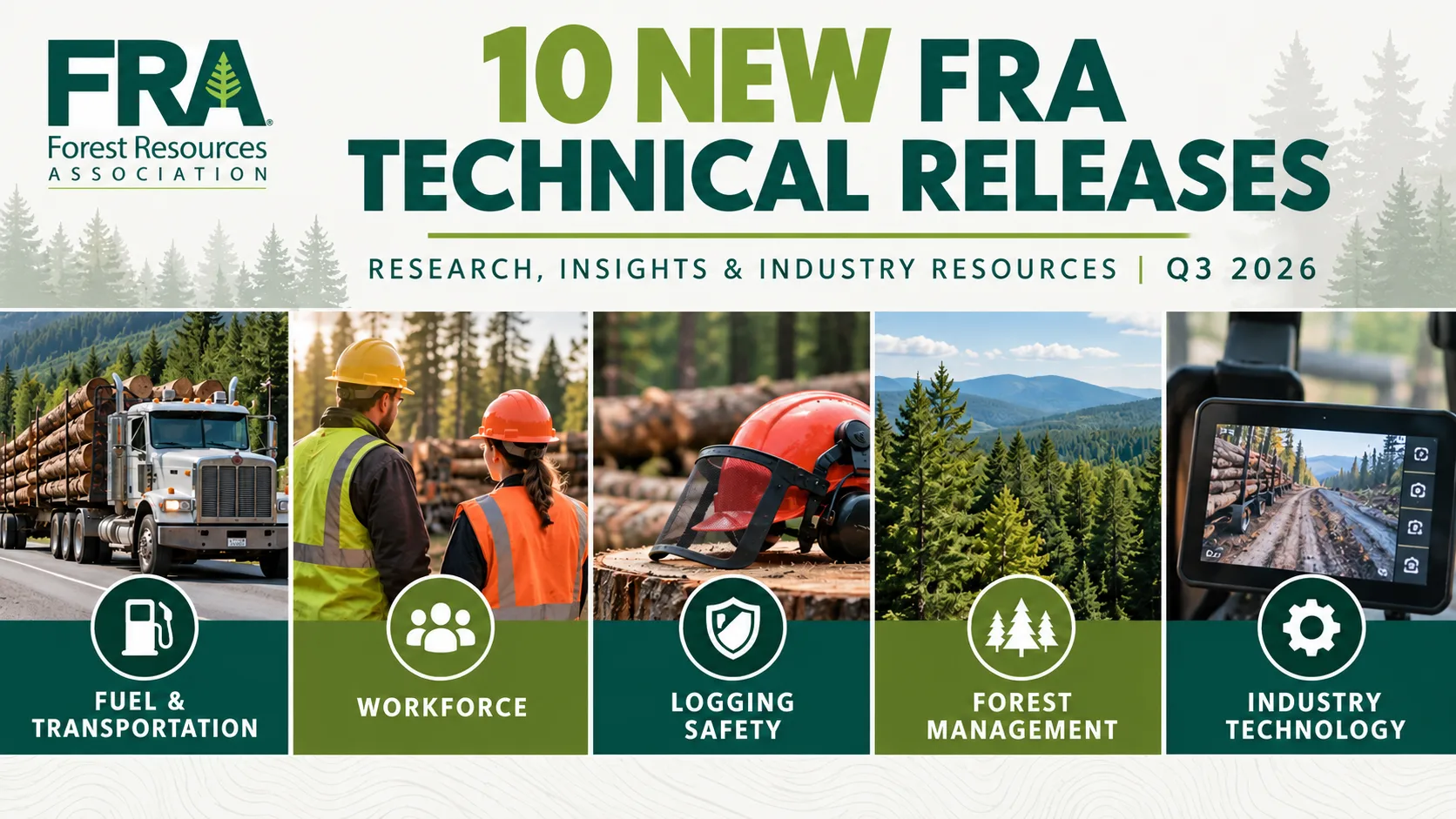
FRA’s 10 latest Technical Releases highlight the breadth of issues affecting the wood supply chain, from rising fuel costs and mill viability to employee retention, forest management, and new approaches to industry communication.
Transportation Costs and Business Planning
26-TR-24: Update on Impact of Skyrocketing Fuel Prices on Forest Products Transportation
Rising diesel prices have significant consequences for transporting raw forest products. Based on the study’s assumptions, the increase in diesel prices between September 2025 and September 2026 is estimated to have added an average of $2.12 per green ton to delivered wood costs, equivalent to more than $920 million in additional annual transportation fuel costs across the sector. The findings demonstrate how energy costs affect businesses throughout the wood supply chain.
26-TR-28: Using the Futures Market to Budget for Diesel Price
Predicting diesel costs can be difficult, but futures market data can offer useful guidance. This release explains how businesses can combine publicly available diesel futures prices with historical regional pricing information to develop more informed fuel budgets. Although futures prices do not guarantee future costs, they provide an alternative to relying solely on current prices or guesswork.
People, Safety, and Industry Communication
26-TR-25: Telling the Forest Story: Social Media’s Role in Public Education and Engagement
Social media provides an opportunity for forestry professionals to engage directly with the public and share the realities of modern forest management. Drawing on the University of Idaho’s experience reaching millions of viewers, this release demonstrates how digital storytelling can educate audiences, address misconceptions, and introduce new generations to the forest products industry.
26-TR-26: Wood & Iron: A Logging Podcast, For Loggers. By Loggers.
Produced by the University of Wisconsin-Stevens Point’s Wisconsin Forestry Center, Wood & Iron brings firsthand logging experiences to an accessible podcast format. Covering business management, workforce development, equipment, safety, and changing market conditions, the program offers logging professionals an opportunity to learn from their peers and exchange ideas across regions.
26-TR-31: Promoting Camera Technology to Improve Safety in the Mississippi Log Trucking Industry
Truck-mounted cameras can provide footage to support driver training, document incidents, and identify driving practices that warrant attention. This release shares findings from three Mississippi workshops attended by 70 business owners and employees. It also identifies the installation and subscription costs that can discourage adoption, illustrating both the benefits and practical challenges of introducing new safety technology.
26-TR-32: Retention Strategies Leading Wood Products Employers Are Using to Keep Their Best People
Retaining experienced employees is increasingly important as wood products manufacturers face labor shortages and competition for skilled workers. This release outlines strategies beyond competitive compensation, including clear career pathways, stronger frontline leadership, employee development, cross-training, and preventing burnout. Its central message is that successful retention requires sustained investment in people.
Forest Management, Markets, and Innovation
26-TR-27: Forest Innovation Platform, a Forest Information Tool
Developed by American Forests, the Forest Innovation Platform provides free access to more than 40 datasets that can support forest management decisions. Users can evaluate information such as timber volume, forest conditions, wildfire risk, and projected environmental changes for specific geographic areas. The tool demonstrates how accessible data can help land managers better understand forest resources and potential risks.
26-TR-29: Techno-Economic Viability Assessment of the U.S. Wood-Consuming Pulp & Paper Industry
Pulp and paper mills serve as important markets for wood fiber, and their closures can affect the entire supply chain. Highlighting an analysis conducted by AFRY for the U.S. Endowment for Forestry & Communities, this release reports that AFRY’s assessment identifies nearly 20 U.S. pulp and paper mills at elevated or moderate risk of closure in the medium term, representing approximately 30 million green tons of annual wood demand. The findings underscore the importance of mill viability to forest management, logging operations, and other wood-consuming businesses.
26-TR-30: What to Do if You Encounter a Cemetery or Other Areas of Importance in the Forest
Forest management sometimes reveals historic cemeteries, former homesites, and other culturally or locally significant features. This release offers practical guidance for identifying, documenting, marking, and protecting these areas before and during forestry operations. It emphasizes communication with landowners, awareness of applicable requirements, and careful planning to preserve important sites.
26-TR-33: FY26 NEPA Efficiency and Timber Volume Positioning
The USDA Forest Service reports improvements in environmental review efficiency across Pacific Regions 5, 6, and 10. During fiscal year 2026, the regions signed 98 National Environmental Policy Act (NEPA) decisions, with environmental assessment decision times improving by 34% compared with FY25. The release also highlights efforts to coordinate environmental planning with future timber sale schedules, helping position the regions to deliver more predictable timber supply.
Why Technical Releases Matter
While these releases cover very different subjects, they share a common purpose: making valuable information available to the people who can put it to use.
A logging contractor evaluating new safety technology, a mill manager considering workforce retention strategies, or a forester exploring digital mapping tools may face different day-to-day decisions. Yet each operates within a connected industry where changes in one sector can affect another. FRA’s Technical Releases help bridge those connections by sharing research, operational experiences, and lessons from across the country.
Technical Releases also reflect the diversity of expertise that supports the forest products industry. Researchers, foresters, logging professionals, manufacturers, transportation specialists, and industry partners all contribute knowledge that can help businesses make informed decisions, improve operations, and navigate changing industry conditions.
As we celebrate National Forest Products Week, we recognize not only the essential products, jobs, and economic contributions of the industry, but also the collaboration and shared expertise that support its continued success.
Explore these releases and more in FRA’s Resource Library.
Learn more about the industry through FRA’s Wood Supply Chain Schematic.