Summary of Business: FRA 2026 Joint National and Lake States Region Fall Meeting

FRA’s Joint National and Lake States Region Fall Meeting brought members and friends from across the country to Green Bay, WI, September 29 to October 1, for committee business, informative educational sessions, and valuable connections with peers from every segment of the wood supply chain.
Thank you to everyone who joined us! If you attended, we ask that you please take a few minutes to complete our short meeting survey. Your feedback will help us shape future FRA events to better reflect your interests and priorities.
Over the course of the meeting, members heard insights from a slate of dynamic speakers:
- Doug Schwartz – President, Billerud North America
Billerud’s Way Forward in Changing Times - Brent Keefer – CEO, American Forest Management
From the Forest to the Mill: The Landowner’s Dilemma and the Future of Wood Supply - Pete Madden – President & CEO, US Endowment for Forestry and Communities
Forest Markets Matter - Pete Stewart – President & CEO, ResourceWise
The Global Pulp Market Dynamics: What It Means for the US Wood Supply Chain - Haroon Syed – Vice President at Dedicated, Schneider
The Road Ahead: Trucking Capacity, Costs, and the Future of Forest Products Transportation. - Ken Zwick – Assistant Director, Forest Products Laboratory
Sustainable Solutions from the Forest Products Laboratory - Jim Ellis – Senior Political Analyst, BIPAC
2026 Midterm Elections - Tim O’Hara – FRA President & CEO
FRA Public Policy / Advocacy Update
Please click the titles above to view the presentations we have permission to share on the FRA website. To access them, you must sign in as an FRA member. Please contact FRA’s Director of Communications and Outreach, Vanessa Connelly, at [email protected] if you need assistance.
Meeting Speakers
Throughout the three-day meeting, speakers shared insights on key issues, emerging trends, and opportunities across the forest products supply chain.
Congressman Tom Tiffany (R-WI-07) offered his perspective on Wisconsin’s forestry and forest products industry, emphasizing active forest management, domestic timber production, and the importance of logging and mill businesses to rural communities. He also discussed Wisconsin’s broader economic outlook, outlining his view that lower taxes, affordable and reliable energy, and fewer regulatory barriers are essential to attracting investment and supporting job growth. Looking ahead to the gubernatorial election, Rep. Tiffany highlighted his pledges to freeze property taxes, reduce income taxes for working families, streamline permitting, and improve accountability in state government, alongside his priorities for stronger schools, public safety, and infrastructure.
Doug Schwartz, President of Billerud North America, discussed the challenges and opportunities facing the forest products industry, including economic and policy uncertainty, changing market demand, and growing interest in sustainable packaging. He outlined Billerud’s strategy to maintain its core paper business while expanding into fiber-based packaging through targeted investments at its Escanaba and Quinnesec mills. Schwartz noted that this transition is expected to increase the company’s wood fiber consumption, creating opportunities for the regional supply chain. He also highlighted pressures facing suppliers, including declining markets for other forest products, fuel and equipment costs, and limited logging capacity. His presentation emphasized the importance of strong fiber markets, sustainable forest management, and industry collaboration on safety, workforce development, and advocacy to support long-term growth.
Brent Keefer, CEO of American Forest Management, examined how changing timber markets and landowner decisions are shaping the future of wood supply. He highlighted persistent sawtimber oversupply in the South, increasing regulatory constraints on Western timber availability, and declining pulpwood markets that are prompting landowners to plant fewer trees per acre and adjust thinning practices. Keefer also discussed how recreation, conservation, carbon markets, renewable energy, and development potential are increasingly influencing timberland values and management decisions. While the fundamental investment case for timberland remains strong, he noted that changing land uses, less intensive forest management, regulatory pressures, and wildfire risk could affect future wood availability, with impacts varying by region and unfolding largely over the longer term.
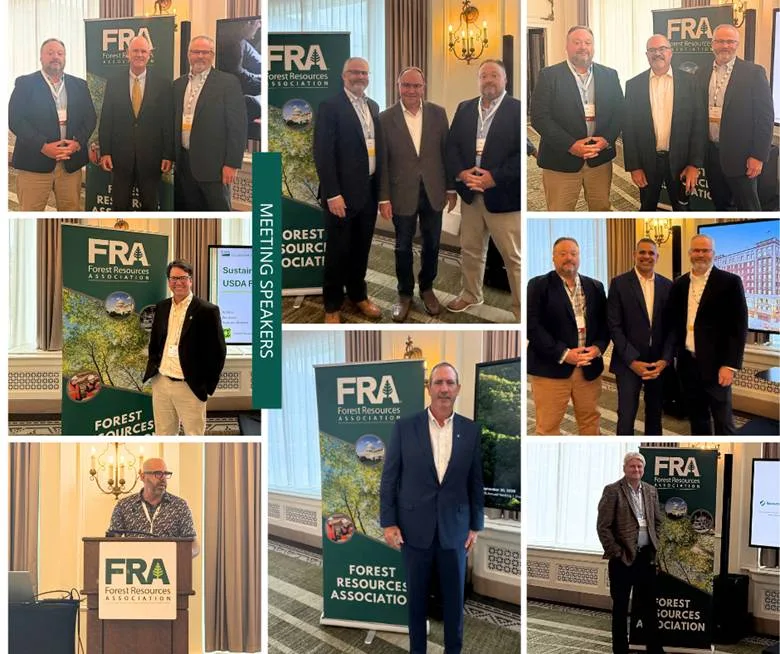
Pete Madden, President and CEO of the U.S. Endowment for Forestry & Communities, discussed the urgent need to strengthen markets for small-diameter wood, manufacturing residues, and residual fiber as mill closures and global competition place pressure on the forest supply chain. He highlighted the importance of preserving existing mills, infrastructure, and workforce capacity while developing new demand through biomass energy, biofuels, innovative packaging, and other wood-based products. Madden outlined the Endowment’s Markets Matter Action Plan, emphasizing coordinated policy support, access to investment capital, and financing approaches that recognize the public benefits of forest management. He also described the Endowment’s investments in emerging businesses and technologies and encouraged industry participation in regional projects, advocacy, and partnerships to build durable markets that support healthy forests and rural communities.
Pete Stewart, President and CEO of ResourceWise, examined what it would take to attract renewed investment in the U.S. pulp and paper industry. He emphasized that global growth in packaging, tissue, and market pulp is being concentrated outside North America, where newer facilities and lower production costs create competitive advantages. Stewart highlighted Brazil’s increasing exports as a significant challenge for U.S. mills and outlined the need for substantial modernization, supported by policies, loan guarantees, and grants that help reduce investment risk. He also discussed emerging markets for residual wood fiber, including renewable fuels, biochar, biocarbon, and wood-fiber insulation, while stressing the importance of proven technology, committed buyers, and viable project economics. His central message was that a competitive pulp and paper sector remains essential to healthy wood markets and the broader forest supply chain.
Haroon Syed, Vice President of Dedicated, Schneider, provided a transportation market outlook, highlighting how rising operating costs, driver shortages, and carrier exits are tightening trucking capacity and increasing freight rates. He explained that the market shift is being driven largely by reduced capacity rather than stronger freight demand, with fuel volatility, regulatory enforcement, and higher equipment and insurance costs adding pressure. For the wood supply chain, these conditions create challenges for logging and hauling contractors and increase the risk of higher delivered wood costs and service disruptions. Syed encouraged members to plan transportation needs earlier, use transparent fuel surcharge arrangements, improve efficiency and site access, and strengthen long-term carrier relationships. He also emphasized that supporting driver retention and contractor viability is a shared responsibility across the supply chain.
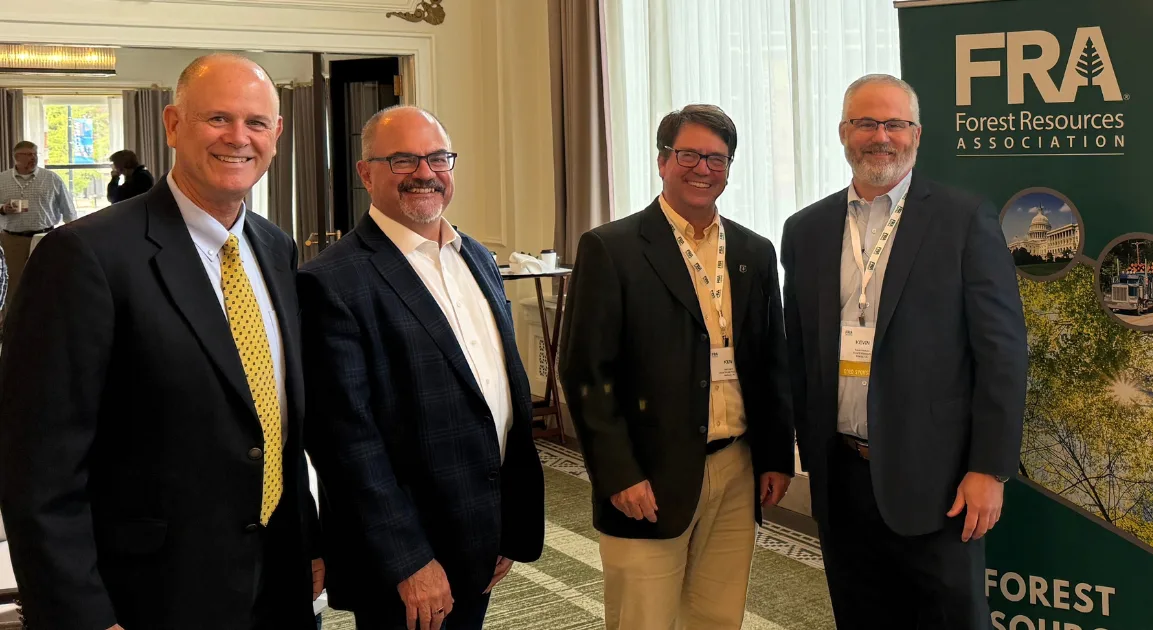
Doug Schwartz, President of Billerud North America, Brent Keefer, CEO of American Forest Management, Ken Zwick, Assistant Director of the USDA Forest Products Laboratory, and Kevin Hudson, Sr. Vice President, Smurfit Westrock, FRA Chairman of the Board
Ken Zwick, Assistant Director of the USDA Forest Products Laboratory, highlighted research aimed at strengthening wood markets and supporting active forest management. He outlined priorities to help pulp mills remain competitive, expand uses for pulpwood and residuals, and improve housing affordability through wood construction and engineered products. Examples included nanocellulose technologies that improve paper strength and packaging performance, alternatives to plastic coatings and PFAS treatments, and biochar applications in composites, soil improvement, and pollution control. Zwick also discussed research on wood durability, mass timber building performance, and biorefinery processes. His presentation emphasized the connection between innovation, a healthy forest products industry, and the markets needed to sustain productive forests.
Jim Ellis of BIPAC provided an overview of the 2026 midterm election landscape, examining presidential and party approval ratings, challenges facing incumbents, and key races that could determine control of Congress. He examined competitive Senate and House contests, each party’s potential path to a majority, and the influence of redistricting and court decisions on House races
Ellis also highlighted the 36 gubernatorial races on the ballot and offered a longer-term perspective on population shifts and projected congressional reapportionment following the 2030 Census, including their potential implications for future elections.
FRA President and CEO Tim O’Hara provided an advocacy report highlighting FRA’s continued work on workforce development, transportation efficiency, forest products markets, and regulatory issues as major congressional decisions shift to the post-election session. Priorities include advancing Farm Bill provisions supporting forestry workforce training, wood innovation grants, biomass carbon neutrality, and forest inventory programs, along with truck weight reforms modeled on the Safe Routes Act. FRA also continues pressing for supplemental H-2B visas and improvements to guestworker programs to address forestry employers’ labor needs. Other efforts focus on reducing burdens associated with the European Union Deforestation Regulation and preparing comments on proposed changes to federal water and forest management rules. With legislative timelines uncertain, FRA remains focused on securing opportunities to advance these priorities before year-end.
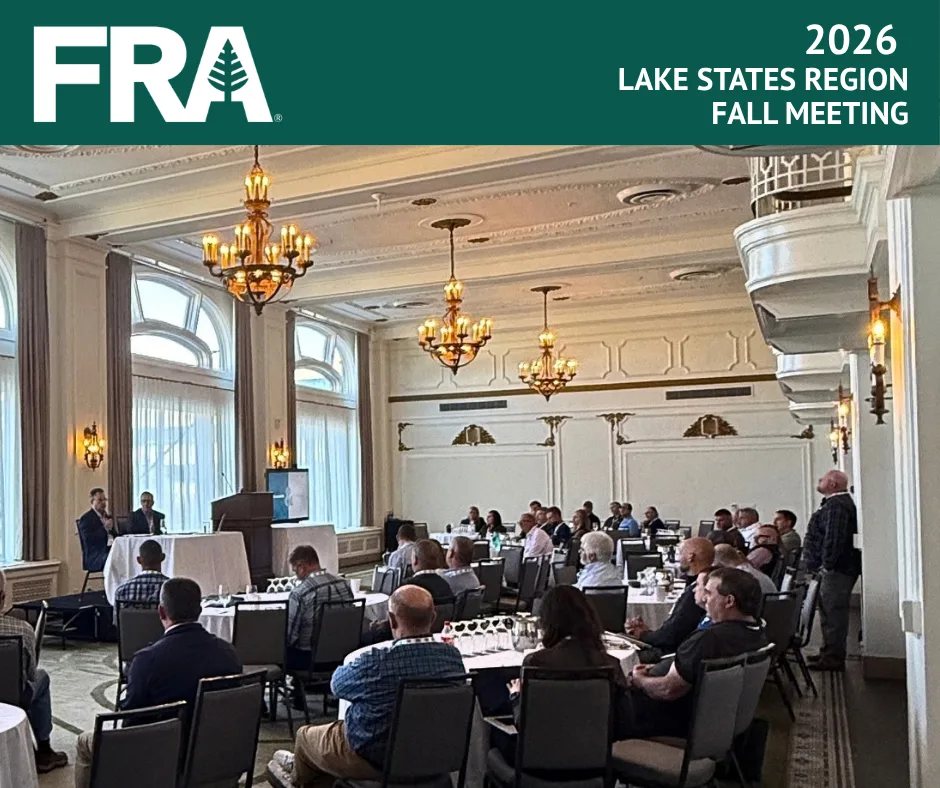
FRA Lake States Region Meeting
At the September 29 Lake States Region meeting, attendees heard speakers present issues affecting member companies in the region and across the country.
The session began with a Lake States Region Association panel featuring Ray Higgins, Executive Vice President of the Minnesota Timber Producers Association; Tom Radovich, Executive Vice President of Minnesota Forest Industries; and Rebekah Luedtke, Executive Director of the Wisconsin County Forests Association. Ray began with a high-level overview of the state of the industry in Minnesota from the perspective of his Association. He then turned it over to Tom for a more in-depth look at the issues affecting Minnesota.
Tom discussed developments affecting Minnesota’s forest products sector, focusing on forest management, markets, and state policy. He highlighted financial pressures on public timber programs as declining wood prices, rising costs, and inconsistent reforestation funding strain operating budgets. Radovich noted that many forest products companies have maintained financial stability despite trade uncertainty and inflation, while identifying concerns about the staffing and cost impacts of state employment mandates. He outlined MFI’s efforts to strengthen engagement with state leaders, build partnerships with conservation organizations, secure reliable reforestation funding, and advocate for policies that support a competitive forest products industry and a dependable wood supply.
Rebekah highlighted the role of Wisconsin’s 30 county forests, which cover more than 2.41 million acres and support timber production, recreation, wildlife habitat, and local government revenue. She reviewed declining timber sale volumes and bidder participation, noting that fewer markets and contractors are limiting management activity, even as certain species and accessible harvest sites remain competitive. Luedtke also outlined challenges related to budgets, staffing, forest regeneration, and growing recreation demands. WCFA’s priorities include protecting forestry program funding, increasing support for roads and habitat management, and undertaking a statewide economic impact study to better document county forests’ contributions to jobs, businesses, and rural communities.
Scott Suder of the Wisconsin Paper Council and Tom Hittle of the Wisconsin Council on Forestry introduced Wisconsin Forests FIRST, a two-year initiative supported by a $1 million state grant to develop a statewide forest industry strategic roadmap. The effort combines research on markets, wood supply, workforce, and forest health with industry input to identify priorities for investment and action. Preliminary findings highlighted Wisconsin’s substantial and growing timber resource, while noting that landowner decisions, logging capacity, and market conditions influence how much wood reaches the market. The presenters emphasized the need to retain and modernize existing manufacturing, address workforce needs, and bring emerging wood products to commercial scale. The roadmap, due by December 2027, will identify recommended actions, resource needs, and responsible partners to strengthen the sector’s long-term competitiveness.
Steve Kuennen of the U.S. Forest Service discussed the agency’s direction for active forest management, including efforts to increase timber production, reduce wildfire risk, and expand reforestation. He outlined organizational changes intended to bring decision-making closer to the field, along with efforts to streamline environmental reviews, update agency policies, and improve project implementation. Kuennen emphasized the role of partnerships with states, Tribes, industry, and local communities, including the use of Good Neighbor Authority and stewardship agreements. He also highlighted wood innovation grants, financing, and market development initiatives that support manufacturing capacity and demand for forest products. While active management remains a priority, he identified market conditions, critical vacancies, and adaptation to organizational changes as ongoing challenges.
Bill Johnson, President of Johnson Timber Corporation provided an overview of the planned biorefinery in Hayward, Wisconsin, a partnership with Synthec Fuels to convert woody biomass into sustainable aviation fuel. The proposed facility would create a new market for mill residuals, low-value wood, and other underutilized forest material, helping address the loss of wood demand following regional mill closures. The project offers potential benefits for landowners, logging and trucking businesses, and rural communities by supporting jobs and providing additional outlets for material generated through forest management. Its development represents an opportunity to diversify the Lake States’ forest products economy and connect the region’s wood supply with growing demand for renewable aviation fuels.
Scott Bowe of the University of Wisconsin presented an overview of hardwood lumber markets, drawing on research with Matthew Bumgardner of the USDA Forest Service. The presentation highlighted declining production and consumption, along with an estimated 31% reduction in the number of Eastern U.S. hardwood sawmills since 2005. Demand has weakened across major markets, with exports and furniture experiencing the largest percentage declines between 2017 and 2025. Bowe also examined competition from wood-look substitutes, shifts in furniture imports, and the importance of export markets for different hardwood species. The findings illustrated the broad pressures facing hardwood producers and the challenges of sustaining demand across both appearance-based products and industrial uses such as pallets and railroad ties.
FRA Lakes States Region Award Presentations
During the meeting, FRA, in partnership with John Deere, presented the 2026 Lake States Region Outstanding Logger Award to J&A Logging of Wright, Minnesota. Ray Higgins of the Minnesota Timber Producers Association highlighted the Anderson family’s three-generation logging legacy and the company’s commitment to safety, environmental stewardship, sound business practices, and community involvement. Jesse Anderson accepted an engraved crosscut saw plaque and award check on behalf of his family and the J&A Logging team.
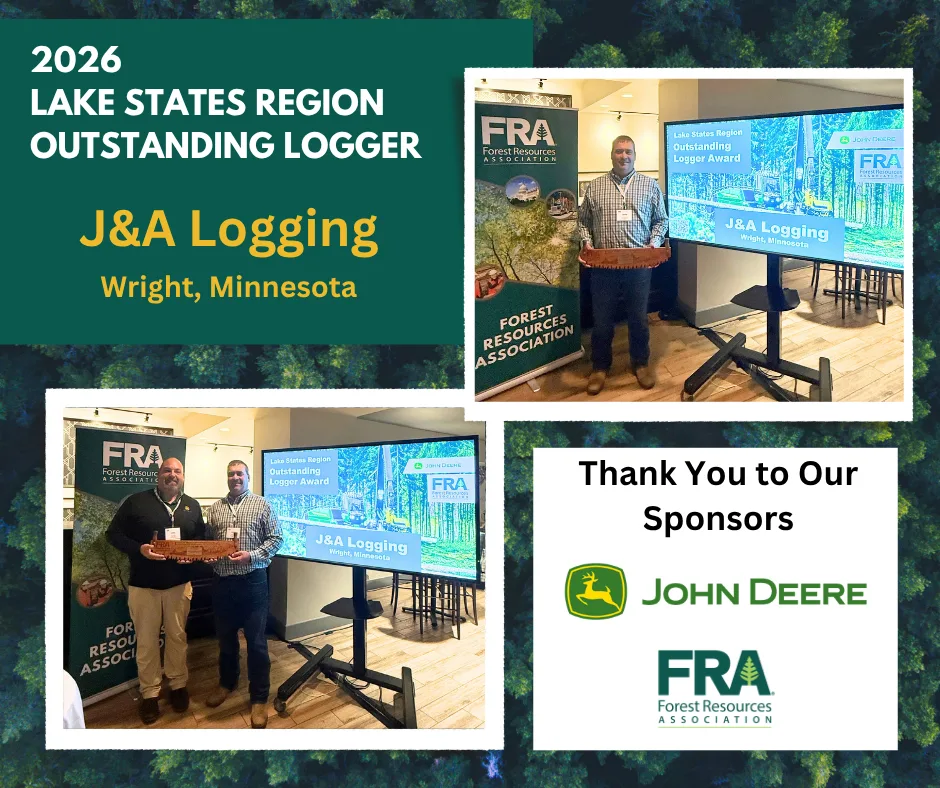
Jesse Anderson of J&A Logging
Wright, Minnesota
Click Here for Press Release
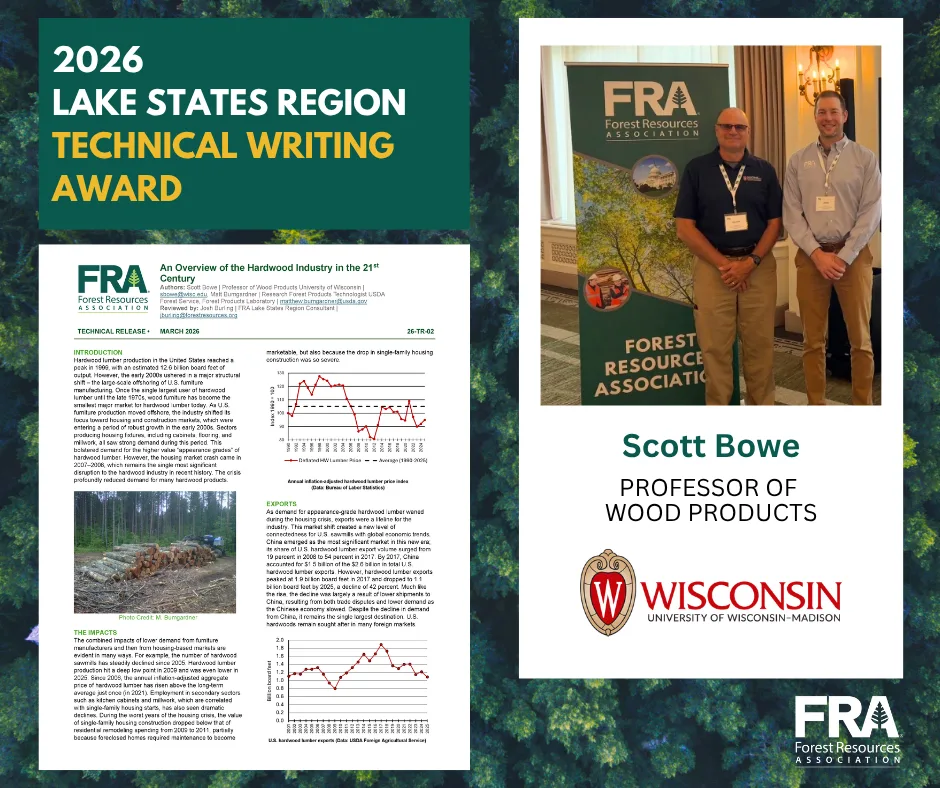
Scott Bowe, Professor of Wood Products, University of Wisconsin – Madison
An Overview of the Hardwood Industry in the 21st Century
Click Here for Press Release
Scott Bowe of the University of Wisconsin and Matt Bumgardner of the USDA Forest Service’s Forest Products Laboratory were recognized as the 2026 Lake States Region Technical Writing Award winners for their Technical Release, “An Overview of the Hardwood Industry in the 21st Century”. Their work examines the major shifts shaping the U.S. hardwood industry, including changes in domestic manufacturing, housing demand, export markets, and competition from substitute materials. The award recognizes their contribution to advancing industry understanding and providing valuable insights for the forest products supply chain.
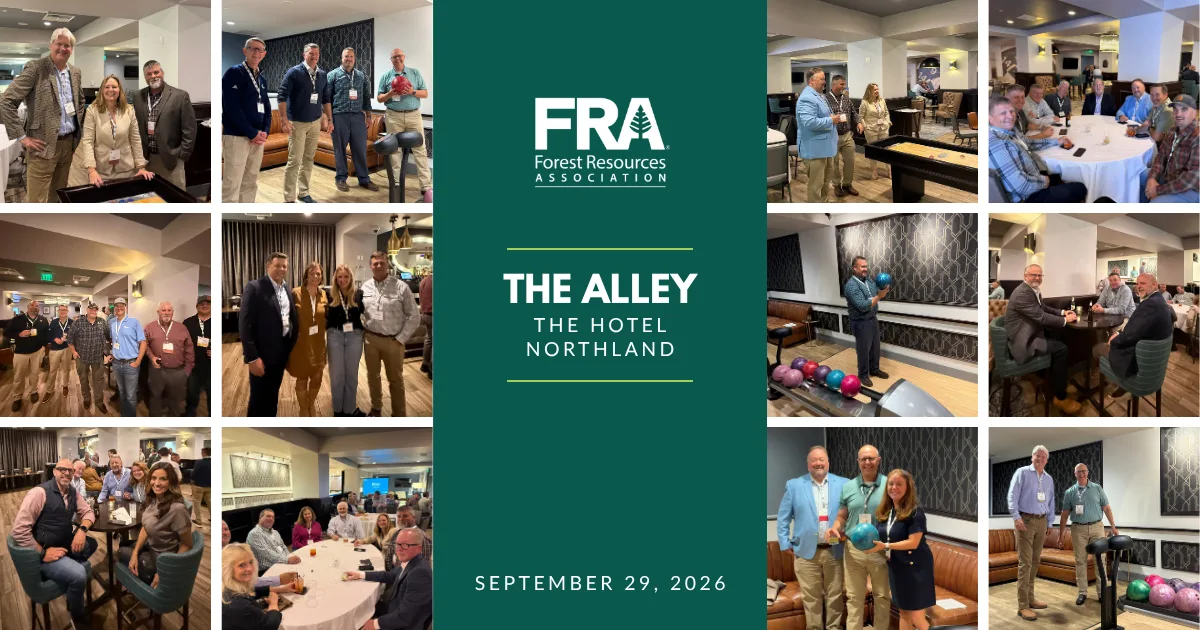
Social Reception at The Alley
Following the Awards Dinner, attendees gathered at The Alley at Hotel Northland for an evening of networking, friendly competition, and fun. The reception offered another opportunity to connect with colleagues in a relaxed setting while enjoying bowling, pool, table shuffleboard, and other games. It was a great way to close out the evening and enjoy the relationships and camaraderie that are an important part of FRA meetings.

Lambeau Field Visit
Wednesday evening brought attendees to historic Lambeau Field for a stadium tour, dinner, and a visit to the Packers Hall of Fame. Guided tours offered a behind-the-scenes look at one of professional football’s most celebrated venues and an opportunity to learn about the traditions that connect the Packers to the Green Bay community. Following the tours, members gathered for a reception and dinner, continuing the day’s conversations and strengthening relationships with colleagues from across the wood supply chain. The evening concluded with dessert and a self-guided visit to the Packers Hall of Fame, where attendees explored exhibits and memorabilia celebrating the team’s history, legendary players, and championship achievements. The outing combined a distinctive Green Bay experience with valuable time for members to connect outside the meeting sessions. FRA thanks Green Bay Packaging for its generous support as the evening’s title sponsor.
National Public Policy/Advocacy Committee
The Public Policy / Advocacy Committee heard a policy review from FRA President Tim O’Hara. His remarks highlighted FRA’s advocacy priorities and ongoing efforts to advance policies that support the forest products industry and the wood supply chain.
National Operations Committee
During the business meeting, the committee reviewed several ongoing projects supporting FRA’s 2026–2028 Strategic Plan.
Woods to Mill Podcast: FRA’s Woods to Mill podcast launched on September 15 with an inaugural episode featuring Tim O’Hara and Josh Sandt. Their conversation explored the wood supply chain, FRA’s role in connecting its many segments, and the priorities guiding the association’s work. New episodes will be released every two weeks through December.
Safe Driving Training: The committee is moving forward with soliciting bids for an educational video focused on safe driving practices for procurement foresters and other company employees traveling on company lands, logging roads, and in other high-risk areas. The project responds to a training need identified by several FRA member companies.
Forestry Fact Sheets: The committee is also planning state or regional fact sheets highlighting key forestry information and statistics, including standing timber inventories, forest growth and removals, and socioeconomic data. These resources will support members’ legislative engagement, economic development outreach, and sustainability reporting, while helping communicate the industry’s contributions to external stakeholders.
National Supplier/Consumer Relations Committee
Following Pete Stewart’s presentation, the Committee reviewed and approved an outline for a white paper on Barriers to New Market Development and Investment and tasked FRA staff with completing the research. Stewart’s remarks provided timely context for the discussion.
The Committee also reviewed a draft white paper on Wood Feedstock Eligibility Under the Federal Renewable Fuel Standard, which examines how restrictions in federal law and EPA regulations limit the types of wood that can be used to produce qualifying biofuels. Members offered questions and suggestions and agreed to circulate the draft to Committee members who were unable to attend for additional feedback before finalizing the paper.
National Timber Harvesting and Transportation Safety Foundation
The National Timber Harvesting and Transportation Safety (THATS) Foundation met on October 1 to review its finances, safety initiatives, grant activity, and future priorities. The committee discussed the completion of Oregon State University’s “Virtual Canopy” grant, with plans to assess project outcomes and identify opportunities to share the work more broadly. Members also considered potential next steps for the Safety Meeting App.
Discussion continued on geo-fencing and other approaches to improve safety around mill operations. Looking ahead to 2027, members explored ways to strengthen fundraising by connecting those efforts more directly to specific safety projects. The committee also considered opportunities to build on previously funded initiatives, including online logger training, to broaden the reach and impact of existing safety resources.
FRA Board of Directors Meeting
At the October 1 Board of Directors Meeting, attendees:
- Reviewed FRA’s financial and operational performance for the fiscal year to date.
- Reviewed the FY2026 Audit Report.
- Received updates from FRA’s National Committees and the THATS Foundation.
- Heard the Meetings Advisory Group’s report on upcoming events, including the 2027 Annual Meeting, scheduled for May 3–5 at the Wyndham Grand in Clearwater Beach, FL. The 2027 Fall Meeting will be held in conjunction with a Legislative Fly-In in Washington, DC, with dates to be announced.
Continuing Education Credits
The FRA 2026 Joint National and Lake States Region Fall Meeting was approved for 8 Category 1 SAF CFE credits. Please reach out if you have questions regarding credit for your meeting attendance.
Meeting Sponsors
Thank you to the FRA 2026 Joint National and Lake States Region Fall Meeting sponsors. This meeting would not have been possible without your generous support!
FRA 2026 Joint National and Lake States Region Fall Meeting Sponsors