Healthy Forests Need Healthy Markets
My first forestry job was a summer position with a small consulting firm in northwest Wisconsin in 2006. I helped set up timber sales for small private woodland owners and, as an eager but inexperienced forester, learned the basics of navigation, tree identification, silviculture, property lines, and harvest boundaries. One thing I do not remember worrying about was whether there would be a market for the stumpage we were selling. At the time, it seemed that every species that met the minimum diameter threshold had a home. That confidence has changed. Today, as more markets have disappeared or weakened, one truth has become increasingly clear: healthy forests depend on healthy markets.
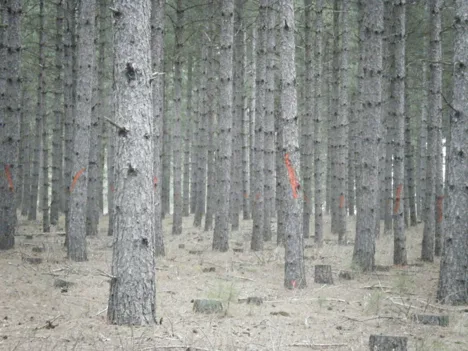
The loss of wood markets has become a growing concern for foresters, loggers, landowners, and policymakers. As timber markets decline, forest management activities needed to improve wildlife habitat, reduce wildfire and forest health risks, and ensure future timber resources become increasingly difficult to carry out. Consider a forester working with a private landowner, perhaps under Wisconsin’s Managed Forest Law (MFL)—the state’s tax incentive program for sustainable forest management—or a public agency managing a stand scheduled for treatment. The stand may be overcrowded and require thinning to improve its health and vigor. It may have invasive species concerns, lack desirable regeneration, or require the removal of lower-quality trees to improve wildlife habitat and create growing space for healthier species. From a forest management perspective, the prescription may be sound, but whether it can be implemented often depends on having a viable market for the wood removed during the treatment.
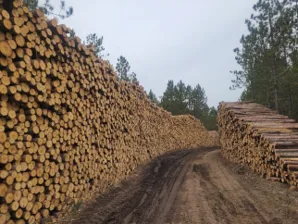
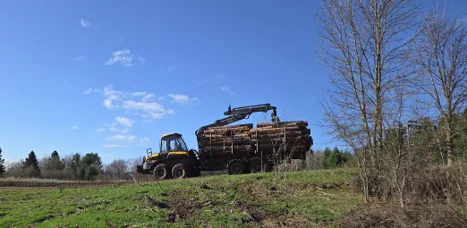
Many trees selected for removal in these treatments are not high-value sawlogs or meet pulpwood specifications of local mills. They may be better suited for chips, biomass, pallet material, or other lower-value products. As markets have waned, low-grade markets have often been hit hardest. Without a market for those products, harvest economics quickly become more difficult. The combined costs of setup, harvesting, trucking, and processing can exceed the wood’s value across the supply chain. That pressure is increasingly visible across the Lake States. Weak pulp markets, oversupplied hardwood markets, housing-related slowdowns affecting lumber demand, volatile mill purchasing patterns, and significant mill closures have created ripple effects for loggers, truckers, contractors, landowners, and mills. The Wisconsin Department of Natural Resources has noted that while harvestable timber remains available on the landscape, many landowners now struggle to find logging contractors and viable markets for certain wood products. Market conditions and changing demand continue to shape which forest management activities can realistically occur. This highlights a reality that wasn’t always such a concern. Sustainable forestry is not just a science-based system; it is also an economic system.
As we all understand, the forest products industry supports thousands of jobs and generates significant dollars in product output. Trees are harvested through responsible forest management into products people use every day. Every sawmill, pulp or paper mill, mat facility, pellet facility, pallet manufacturer, pole processing plant, and specialty wood products company provides benefits to society and helps keep forests manageable. Each lost market creates ripple effects throughout the supply chain, reaching all the way back to the forest. When markets exist at scale for low-grade wood, foresters can implement silvicultural treatments that improve stand quality, landowners can afford needed treatments, logging contractors can keep operating, and mills can secure raw material, and we all benefit from the healthy forests, wildlife habitat, and products they produce. The result is healthier forests and stronger rural economies. As those markets decline, management opportunities decline with them.
One of the best parts of working in the forest products industry is seeing the resilience of the people in it. Industry leaders, government agencies, educational institutions, and stakeholder organizations like FRA are actively working to address today’s market challenges. The Wisconsin Forests FIRST initiative is one example of this work in action. It focuses attention on the connection between sustainable forestry, forest products manufacturing, workforce development, and economic growth. Efforts like this recognize that healthy forests require the infrastructure and markets that support active forest management (For an in-depth update on the Wisconsin Forests FIRST initiative, consider attending the FRA Fall Meeting in Green Bay, Wisconsin, September 30–October 1).
The Lake States remain fortunate to have abundant forest resources, a strong manufacturing base, and a long tradition of sustainable forest management. Existing forest product markets are essential to keeping sustainable forest management economically viable. However, as traditional markets have declined, the need to develop new outlets for harvested wood and residuals must be explored. New opportunities for underutilized wood resources which could complement traditional markets have emerged, including mass timber, wood pellets, bioenergy, biochar, and potentially woody biomass as a feedstock for sustainable aviation fuel. These emerging markets could create additional outlets for lower-value wood, improve forest health and productivity, and strengthen the economic foundation needed to support future forest management and the broader supply chain. Success will require continued collaboration and consensus on the best path forward to maintain the viability of existing mills while attracting new mills where resources are underutilized. That message was central to the recent Markets Matter Convening in Madison, Wisconsin, where participants from across the forest products supply chain discussed the need to maintain and expand markets for sustainably produced wood. The event reinforced a reality familiar to forestry professionals and highlighted the need for collaboration to support the industry’s future. For more on Markets Matter initiatives, register for FRA’s August webinar, Markets Matter: From Convening to Action — Join Us in Building the Markets Our Forests Need.
Healthy forests need healthy markets. Without strong, reliable outlets for wood, especially lower-value material, the management options needed to keep forests healthy can become limited or disappear altogether. The forest products industry is meeting these challenges head-on through initiatives such as Wisconsin Forests FIRST, Markets Matter, and other collaborative efforts across the supply chain. Each of us has a role to play in supporting the markets, partnerships, and innovation needed to sustain both healthy forests and a strong forest products industry.
Sources:
- Wisconsin Department of Natural Resources, 2026 Wisconsin Forest Products Market Update: https://forestrynews.blogs.govdelivery.com/2026/02/18/2026-wisconsin-forest-products-market-update/
- Wisconsin Forests FIRST materials: https://councilonforestry.wi.gov/Pages/WIForestsFIRST.aspx
- Wisconsin DNR Forestry News, Markets Matter Convening Highlights: https://forestrynews.blogs.govdelivery.com/2026/06/17/markets-matter-convening-highlights/