The Wisconsin Forestry Center
Making a Positive Impact on Workforce Development and Recruitment
Workforce development continues to be one of the forestry supply chain’s biggest challenges—a reality highlighted during FRA’s recent Washington, D.C. fly-in, where advancing the Jobs in the Woods Act was a top priority. The Jobs in the Woods Act establishes a competitive grant program to help address forestry workforce shortages by funding career pathway training in rural and underserved communities. The numbers demonstrate concerning trends for future workforce capacity across the supply chain. Notably, the average logging business owner is 55 years old, and approximately 30% plan to retire or leave the business within five years. Rural forest-based communities are losing young adults, with 40-60% planning to leave the communities where they were raised. Retirements and out-migration cause mill labor shortages, hindering facility modernization and investment. Multiple approaches will be necessary to shift these trends in a favorable direction. The Wisconsin Forestry Center (WFC) is tackling this challenge head-on.
The Wisconsin Forestry Center (WFC) is an outreach center within the College of Natural Resources (CNR) at the University of Wisconsin-Stevens Point (UWSP). It is a partnership with the University of Wisconsin-Madison’s Division of Extension. WFC’s objective is to serve the needs of Wisconsin’s forestry community by focusing on partner-driven professional development, workforce recruitment and development, applied research, and community outreach initiatives. In 2022, WFC was awarded a $7.9 million grant from the Wisconsin Economic Development Corporation (WEDC) through the Department of Workforce Development. The grant’s primary objectives were to create and implement forest industry workforce development programs, build the supporting infrastructure and curricula, and establish the partnerships needed to guide and sustain these efforts.
Through the workforce development grant, the WFC hired Outreach Specialist Jared Schroeder to develop a high school curriculum and field program to engage and educate the future workforce. Jared brings an outstanding combination of education and experience to the role. He graduated from UW-Stevens Point with a bachelor’s degree in Wildlife and Biology and had 14 years of high school biology teaching experience before joining WFC.
As part of the WEDC grant, the WFC developed a high school curriculum and a summer field experience tailored to high school students, with the objective of providing broad exposure and multidisciplinary education related to the forestry supply chain and potential career pathways. The high school curriculum modules include:
- Tree Biology and Identification
- Forest Health
- Forest Management
- Forest Products
Each module includes a full PowerPoint presentation that provides students with a hands-on experience in the classroom. The modules can be used partially or fully and each can be used independently or in combination with others, offering teachers flexibility to tailor the materials to their students’ unique needs. LEAF (the Wisconsin Center for Environmental Education’s K-12 Forestry Education Program) has helped the WFC develop a complementary set of career cards that can be integrated into the program, helping students understand different career paths in the industry. Following the development of the modules, the WFC ran a pilot program at a local Wisconsin high school. Since then, the WFC has implemented the program in over 30 schools in Wisconsin. It has even been introduced to a school in Idaho, although tailored to that region’s unique differences. The curriculum is also being implemented in both Minnesota and Georgia. The curriculum is free for teachers who wish to implement it.
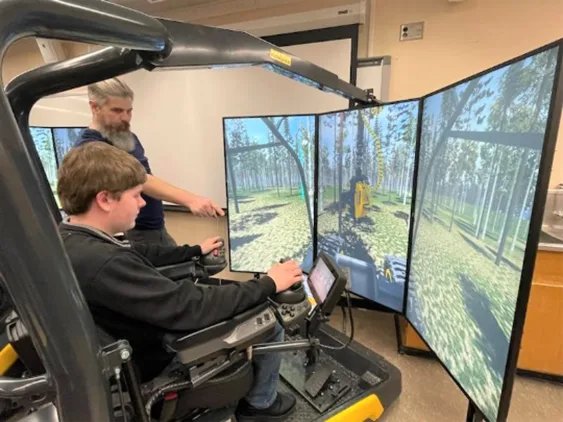
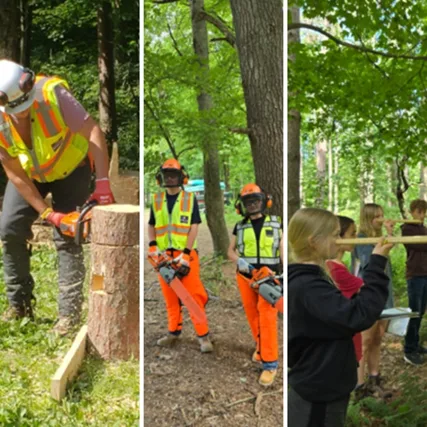
In addition to developing the high school classroom curriculum, the WFC has developed a summer Forestry Skills Camp, which they are working to finalize for the summer of 2026. The field camp is a one-week camp held at the CNR’s Central Wisconsin Environmental Station in Amherst Junction, Wisconsin, from June 14-19. Students can apply for one of three progressive paths: Forest Measurement and Management, Forest Products, or Chainsaw Safety and Operation. Each of these tracks offers the opportunity to earn wilderness first-aid certification, hands-on access to Ponsse harvester simulators, and a broad breadth of industry exposure, including a sawmill, a lumber kiln, and even non-timber forest products. Juniors and seniors have the opportunity to receive training in chainsaw operation and safety. Students have provided positive feedback and appreciated the opportunities offered by the portable sawmill and harvesting simulator. This year’s Forestry Skills Camp aims to enroll 25 participants. The cost to attend is $450 per participant for the week and includes 1 credit from UWSP, which can be applied toward a natural resource degree program if students enroll in the College of Natural Resources.
Looking ahead, the high school program curriculum and the summer Forestry Skills Camp have strong opportunities for growth, including expanding outreach to high school teachers, increasing the camp’s visibility, and improving student access by reducing cost barriers. By leveraging various grants, local workforce development scholarships, community foundation support, and private‑sector partnerships, the program can broaden participation and strengthen curricular integration. With the initial workforce grant concluding, these external funding avenues will position the program to build long‑term financial sustainability while continuing to provide high‑impact learning experiences for students.
With every challenge comes opportunity. The WFC is currently refining and adding to the high school curriculum, including a fire component and expanded logging concepts. This fall, WFC will solicit comprehensive feedback on the program to help gauge successes and opportunities in a measurable way. Most high school students have very limited awareness of career opportunities in the forestry supply chain. As such, there is ample opportunity to refine marketing and outreach efforts to broaden the implementation of the curriculum across high schools in the Lake States and beyond.
There are multiple opportunities for FRA members and the broader forestry community to support the program, if interested. WFC is accepting sponsorships to help reduce or eliminate the cost of student attendance at the summer Forestry Skills Camp. They are also seeking individuals who would be willing to participate in career panels to speak to students about their unique career experiences and opportunities. In addition, WFC will develop videos to complement the career cards created by LEAF, which will require volunteers with experience in those careers. Supporting the Jobs in the Woods Act can also have a significant impact. If passed and implemented, this grant program will be an avenue for WFC to potentially secure additional funding.
The momentum we’re seeing across workforce programs is exactly why the Jobs in the Woods Act is so important. It will help expand outreach and strengthen curriculum development through dedicated grant funding. This FRA-led legislation has been included in the House version of the Farm Bill, marking a meaningful step forward in addressing our industry’s workforce challenges. Now is the time to keep that momentum going, reach out to your member of Congress to express your support, and help ensure this critical investment in forestry’s future becomes law.
Find your representative here: https://www.house.gov/representatives/find-your-representative
To learn more about the high school recruitment program at the Wisconsin Forestry Center, please contact:
Jared Schroeder – High School Program Manager (715) 346 2084
Wisconsin Forestry Center: https://www.uwsp.edu/wfc/wisconsin-forestry-center/
Applied High School Curriculum: https://www.uwsp.edu/wfc/wisconsin-forestry-center/wfcc/high-school-curriculum/
High School Forestry Skills Camp: https://www.uwsp.edu/wfc/wisconsin-forestry-center/wfcc/high-school-curriculum/