A Change in Momentum for Lake States Markets?
Like most of the country, the Lake States Region forest products industry has faced challenges since the Great Recession and hasn’t fully recovered. Although there have been occasional successes, market losses and reduced logging and trucking capacity remain issues. I’ve seen these changes firsthand over my 20-year career in forestry.
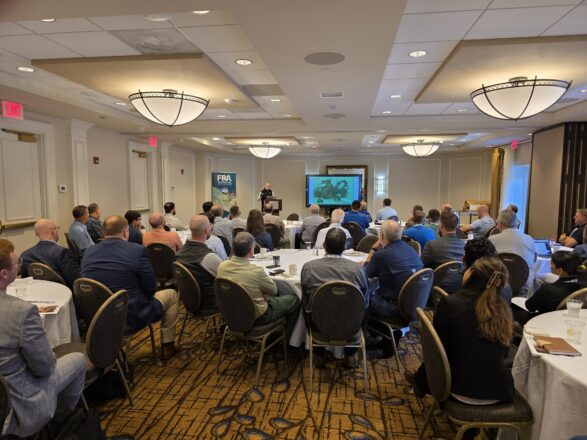
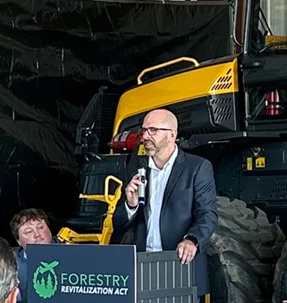
As we conclude 2025 and look forward to 2026 and beyond, opportunities for positive momentum may emerge. In early September, FRA member Johnson Timber/FutureWood Corporation invited FRA to attend an announcement at their Hayward, Wisconsin, facility. The event was well attended, with a broad spectrum of the forest products supply chain represented, along with local media, community leaders, and state politicians.
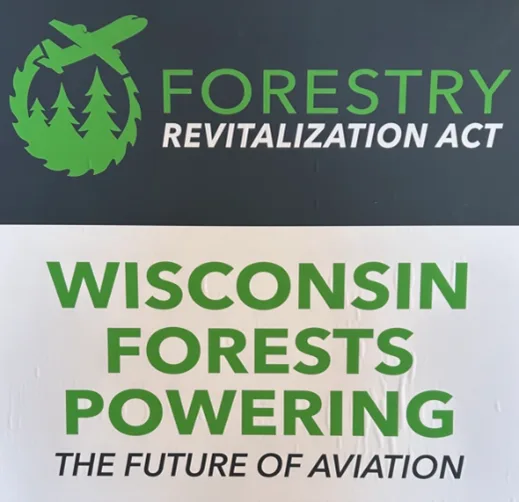
FutureWood Corp/Johnson Timber announced a partnership with a Swiss Corporation to form Synthec Fuels Wisconsin, a proposed Sustainable Aviation Fuels (SAF) Biorefinery in Hayward. The project team is working with the State Legislature on support through the Wisconsin Forestry Revitalization Act, which was shared at the event. Key points about the biorefinery and the Act were discussed by several speakers and further explored by DJ Aderman (President, FutureWood Corporation/Johnson Timber) at the FRA Lake States Region Fall Meeting in October.
Once completed, the facility will mainly use Wisconsin wood fiber to produce jet fuel. A pre-feasibility study, funded by the State of Wisconsin and a U.S. Forest Service Wood Innovations grant, for a pulpwood-using facility siting in the State of Wisconsin, identified Wisconsin as a primary location for an SAF biorefinery. While SAF can be made from various sources, wood is the most homogeneous, and past trials have shown that different tree parts and multiple species can be processed effectively.
Since 2019, Wisconsin has lost between 2.5 and 3.4 million green tons of wood from industry wood utilization, resulting in more available wood fiber. As someone with extensive land management experience, I can attest that declining markets limit sustainable forestry practices. Demand for SAF is expected to grow due to the European Union (EU) and RefuelEU Aviation rules requiring increased blending rates (2% by 2025, 20% by 2035, and 70% by 2050), while limiting other feedstocks. The combination of abundant resources and rising demand creates a major opportunity. Currently, only three U.S. facilities can produce 10 million gallons of SAF annually. Synthec Fuels’ proposed WI facility could produce upwards of 48 million gallons, utilizing 900,000 to 1,000,000 tons of fiber annually, making it the nation’s largest producer.
The Wisconsin Forest Revitalization Act, introduced by State Senator Mary Felzkowski (R-Tomahawk) and Rep. Chanz Green (R-Grand View), plays a key role in advancing the project. Anticipated to require an investment of $1.5-$1.7 billion, the Act would create a partnership with the State of Wisconsin, in which the state would provide $60 million in Wisconsin Enterprise Zone Tax Credits and allocate a $150 million state bonding grant through the forestry account.
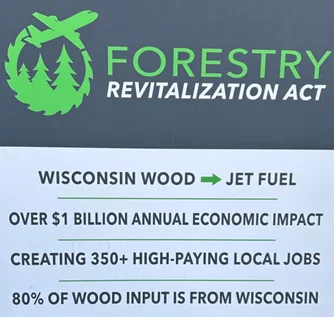
The biorefinery is expected to create 165 direct \ 200 indirect jobs, with 80% of the woody feedstocks sourced from Wisconsin. Developers will use fiber, lacking other market opportunities. There is strong export demand, and domestic markets are projected to grow, potentially leading to a billion-dollar annual economic impact in the region. If funded, the facility would take five years to build, reach full capacity by 2031, and require a three-year production ramp-up.
Since September, progress has been steady. While little information has been made available to the public, the bill has received a hearing in the Wisconsin Senate Committee on Insurance, Housing, Rural Issues, and Forestry, and has subsequently been referred to the Wisconsin Assembly Committee on Ways and Means, where a hearing is anticipated soon. Public input continues to be welcomed and remains ongoing. A vote on the bill is expected in early 2026, and there is optimism it will be passed, though certain details are still under consideration and debate.
If Wisconsin does not proceed with the project, Minnesota and Michigan are also interested, aiming for several facilities in the Lake States Region to strengthen the forest products supply chain. The region’s forest products industry faces sustainability challenges, with losses in markets, logging, and trucking capacity that must eventually stabilize. Ideally, the fiber supply chain would balance growth with demand and available resources. The partnership between Johnson Timber, Synthec Fuels, and Wisconsin could help reverse negative trends and support the rural forest-based economies in the region.