Protecting the Land, Supporting the Logger: Ohio’s Landscape Scale Restoration Program Grant at Work
Jeff Jenkins – FRA Appalachian Region Consultant
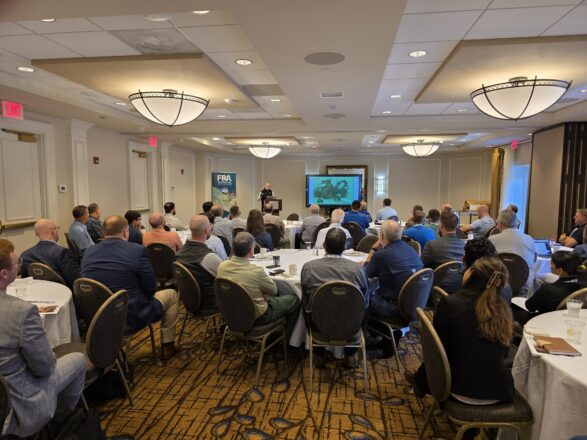
Recently, I attended a Logging Standards Council (LSC) meeting in Columbus, OH. The LSC was established in the mid- to late-1990s to guide and support the Master Logger Program, and makes recommendations to the Loggers’ Chapters through information, education, and legislative action. The discussion that most caught my attention came from the Division of Forestry’s forest hydrology manager, who presented details of a Landscape Scale Restoration (LSR) Program grant approved for Ohio.
The LSR Program, administered by the US Forest Service, is a competitive grant program that promotes collaborative, science-based restoration of priority forest landscapes. To qualify, projects must advance the priorities identified in a State Forest Action Plan or an equivalent restoration strategy, such as a tribal forest plan. Unlike programs that focus on small parcels or isolated work, the LSR Program is intended to operate at a true landscape scale, working across multiple land ownerships or jurisdictions, including state, tribal, private, and local lands. This cross-boundary approach allows managers to address large-scale ecological challenges more effectively.
The Ohio Division of Forestry joined forces with the National Association of Conservation Districts (NACD) to secure this grant. The investment is designed to strengthen sustainable forest management across the state. Through this collaborative effort, Ohio’s logging community stands to benefit directly: participating loggers can access cost-share opportunities, training, and technical support that reduce operational expenses while improving harvest planning and forest health outcomes.
- Professional foresters (ex. consulting and industry foresters) may receive a $200 incentive payment for submitting a management plan known as a Forestry Pollution Prevention Plan (FP3). It has to be reviewed by the county Soil and Water Conservation District (SWCD) staff and approved by the SWCD board of supervisors.
- Loggers who fully implement Best Management Practices (BMPs) in an approved FP3 can earn a $300 incentive once an SWCD inspection confirms that any deficiencies are corrected. Additionally, a one-time $450 payment will be made for properly seeding and mulching all log landings at the end of operations, regardless of landing size, provided every landing in the FP3 is completed. They may also receive an additional incentive for applying seed and establishing temporary grass cover on all skid trails. No mulch is required unless slopes exceed 20%, using wildlife-friendly, weed-free seed mixes. This payment is $10 per 100 lineal feet of skid trail, and all bare soil within the trail system must be seeded to qualify.
- Loggers, foresters, or landowners who choose to install a portable bridge for a stream crossing may receive a 75% cost-share of the actual cost of bridge rental, up to a payment of $1,500.
Before writing this Woods to Mill, I spoke to John Jefferson with Jefferson Logging, a logger who participated in the original pilot project for the new cost-share program. John explained that he initially hesitated to join the program because he was worried it might bring unwanted attention and added scrutiny to his logging job. But confident he had nothing to hide, he agreed to participate. After completing the timber harvest, he contacted the county SWCD office to let them know he was ready for a site visit and inspection of his close-out work. It was successful, and he received the cost-share payment. John said the process was simple: he has always submitted an FP3 plan to the SWCD office, completed the erosion control practices, and follows the Ohio BMPs for Erosion Control for Logging and Forestry Practices handbook.
In the end, John told me he believes the program is a solid one. Grant funding simply reimburses loggers for doing what responsible Ohio Master Loggers already strive to do: protect the land. That principle is exactly why the Landscape Scale Restoration Program grant is such a benefit to both loggers and the state. It rewards good stewardship, supports the costs of implementing BMPs, and strengthens long-term forest health. As more loggers participate, Ohio gains healthier watersheds, more resilient forests, and a stronger, more professional logging sector, proving that what’s good for the land is good for the people who depend on it.